


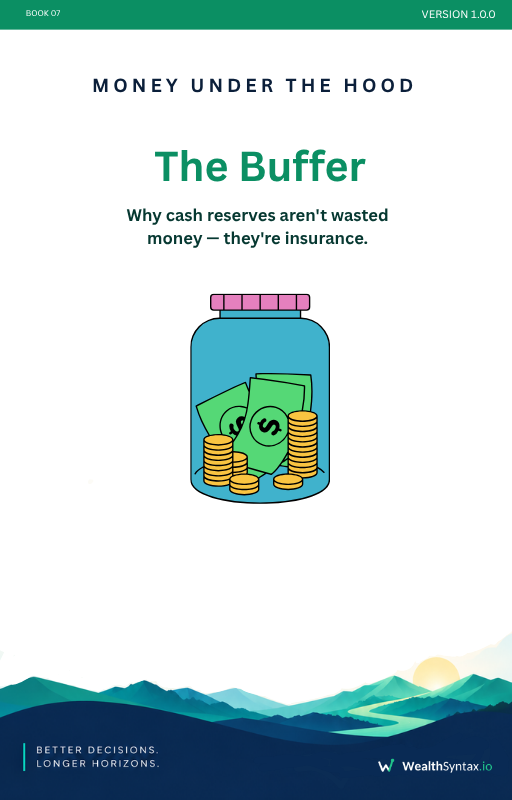
The Buffer
Why cash reserves aren't wasted money — they're insurance
Free. No email required.
What you'll learn
Why cash reserves aren't idle money—they provide system resilience and prevent forced selling of investments.
How to calculate your emergency runway as an amount of time rather than a static dollar balance.
The trade-offs of holding cash: weighing inflation erosion against the high cost of debt and downturn liquidations.
The two-bucket framework: separating short-term availability from long-term compounding growth.
A step-by-step framework to determine, build, and replenish a personal cash buffer.
Inside the book
The Money Under the Hood series
Related systems & calculators
Financial Safety Net Checklist →
Audit your household liquidity, insurance coverage, and debt buffers before scaling investments.
Interactive ToolsWealthSyntax Financial Calculators →
Closed-form models for compound interest, inflation drag, dollar-cost averaging, and drawdown risk.
Frequently asked questions
What is an emergency fund?
An emergency fund is money set aside for unexpected, necessary expenses or temporary income disruptions. It is intended for situations such as unexpected essential repairs, necessary medical expenses, temporary unemployment, and urgent family travel.
Educational context · Money Under the Hood Book 07How do I calculate my emergency runway?
Emergency runway is calculated by dividing your available emergency savings by your essential monthly expenses: Emergency Runway = Cash Reserves ÷ Monthly Essential Expenses. Your emergency fund is not just a dollar amount; it is an amount of time.
Educational context · Money Under the Hood Book 07Isn't cash losing to inflation?
Cash held in reserves does experience purchasing power loss when inflation exceeds interest earned. However, the alternative of having no buffer creates severe risks: forced selling of investments during a downturn or relying on high-interest debt. A buffer accepts an opportunity cost in exchange for financial protection.
Educational context · Money Under the Hood Book 07Where should the buffer live?
An emergency fund needs three core characteristics: accessibility (reachable when an emergency occurs), stability (protected from short-term market fluctuations), and a reasonable return. For US readers, an eligible insured savings account is a primary option, prioritizing availability over chasing advertised yield.
Educational context · Money Under the Hood Book 07